Cox Communications and the Major Labels Take Their Marathon Copyright Dispute to the Supreme Court — Oral Argument Runs Nearly Two Hours Ahead of High-Stakes 2026 Ruling


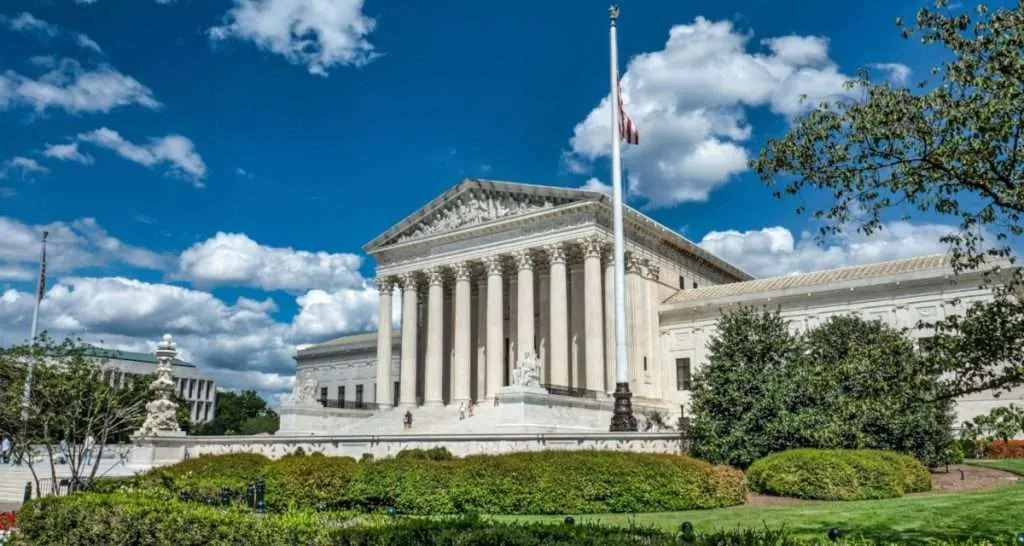
The Supreme Court courtroom. Photo Credit: Phil Roeder
With a billion-dollar lower-court ruling on the line – and with far-reaching implications for the future of ISP infringement liability – the Cox Communications v. Sony Music Supreme Court argument is officially in the books.
That oral argument took place before the nation’s highest court today, nearly six years after a jury ordered Cox to pay a staggering $1 billion in a majors-levied copyright dispute.
Multiple twists and music-space ISP suits later – several cases are paused pending the Cox v. Sony outcome – the involved parties (plus the U.S. government) laid out their positions across the better part of two hours this morning.
If so inclined, we could dive into the case law particulars here. Given the existing presence of voluminous briefs, however, ink would perhaps be better spilled recapping the oral argument’s key hypotheticals and takeaways.
At the top level, Cox doubled down on its assessment of the “cataclysmic” effects that will purportedly result from adopting the majors’ view of contributory liability.
As we previously covered, those effects refer mainly to “[t]urning internet providers into internet police,” wreaking “havoc with the essential medium through which [the] modern public engages in commerce and speech,” and compelling ISPs to permanently boot customers from the web, Team Cox reiterated today.
Furthermore, Cox emphasized its belief “that contributory liability requires malfeasance with the purpose of fostering the bad act” – like, for example, hiding alleged infringers’ IP addresses or creating a service designed to help customers illegally download protected works.
And as its conduct allegedly lacks malfeasance – Cox once again defended its approach to handling infringement notices as well – the ISP argued that it shouldn’t be held liable for hosting repeat infringers whatsoever.
On the other side of the courtroom confrontation, the labels voiced the exact opposite position.
Underscoring a now-former Cox employee’s much-mentioned “F the DMCA!!!” internal email, the music companies indicated that adopting the ISP’s liability position (and purported disregard for the DMCA) would render the safe harbor irrelevant in practice.
“Why bother with a safe harbor?” Team Sony asked. “Why worry about a limitation on liability, which is the expressed text of the DMCA, if there’s no liability to limit? Why bother cooperating with copyright holders? Why bother having a reasonable and appropriate system for taking down repeat infringers if you’re allowed to behave entirely unreasonably?”
On the other side of this coin, the multifaceted argument also covered the idea that Cox, with liability tied directly to knowledge of users’ purported repeat infringement, would perhaps benefit from turning a blind eye to takedown notices altogether.
Is there room for a middle-ground solution in the absence of concrete congressional guidance? Unsurprisingly, possible non-suspension steps between the rightsholder’s infringement notice and a permanent service termination came up during the argument – especially concerning connections (like at colleges) with many users.
Just in theory, this might include Cox’s coordinating with universities, the owners of multi-family dwellings, and others in an effort to stop subscribers’ alleged piracy.
Elsewhere in the argument, the secondary liability relevance of patent and common law took the stage – as did the First Amendment considerations of terminating infringers’ internet access, the idea of directing infringement notices to different service providers (should electric companies cut customers’ power, and in turn their internet, due to alleged piracy?), and a whole lot else.
Addressing the argument in a statement, Cox again mentioned the perceived possibility that the existing ruling, if left in place, could lead to mass internet-account terminations.
“We appreciate the opportunity to present our case to the Supreme Court and are grateful for the Solicitor General’s participation in today’s arguments,” Cox communicated.
“As we have said throughout, internet service providers should not be held liable for the infringement of few customers when the internet provider did not aid, foster, encourage or profit from the alleged conduct. Today’s argument showed how the lower court ruling, if untouched, could jeopardize internet access for all Americans,” the company concluded.
Link to the source article – https://www.digitalmusicnews.com/2025/12/01/cox-v-sony-music-oral-argument/
-
 Stagg WS – BH235 Bb Baritone with Case$486,53 Buy product
 -
Asmuse 39 Inch LP Electric Guitar Kit, Solid Body Les Paul Style Electric Guitar With Volume/Tone Controls, 3-Way Pickup (Black)$159,99 Buy product
-
Civil Era Solid Copper Bugle With Beautiful Rope US Military Cavalry Horn Handmade$59,00 Buy product
-
Monoprice Recording Desk with Raised Platform and Keyboard Tray, Workstation, Stable & Lightweight, for Home Studio Stage Right Series, Black$63,99 Buy product
-
Kaizer Baritone Horn 2000 Series B Flat Bb Gold Lacquer BRH-2000LQ$0,00 Buy product
-
1010music Blackbox Compact Sampling Studio$649,00 Buy product



Responses